
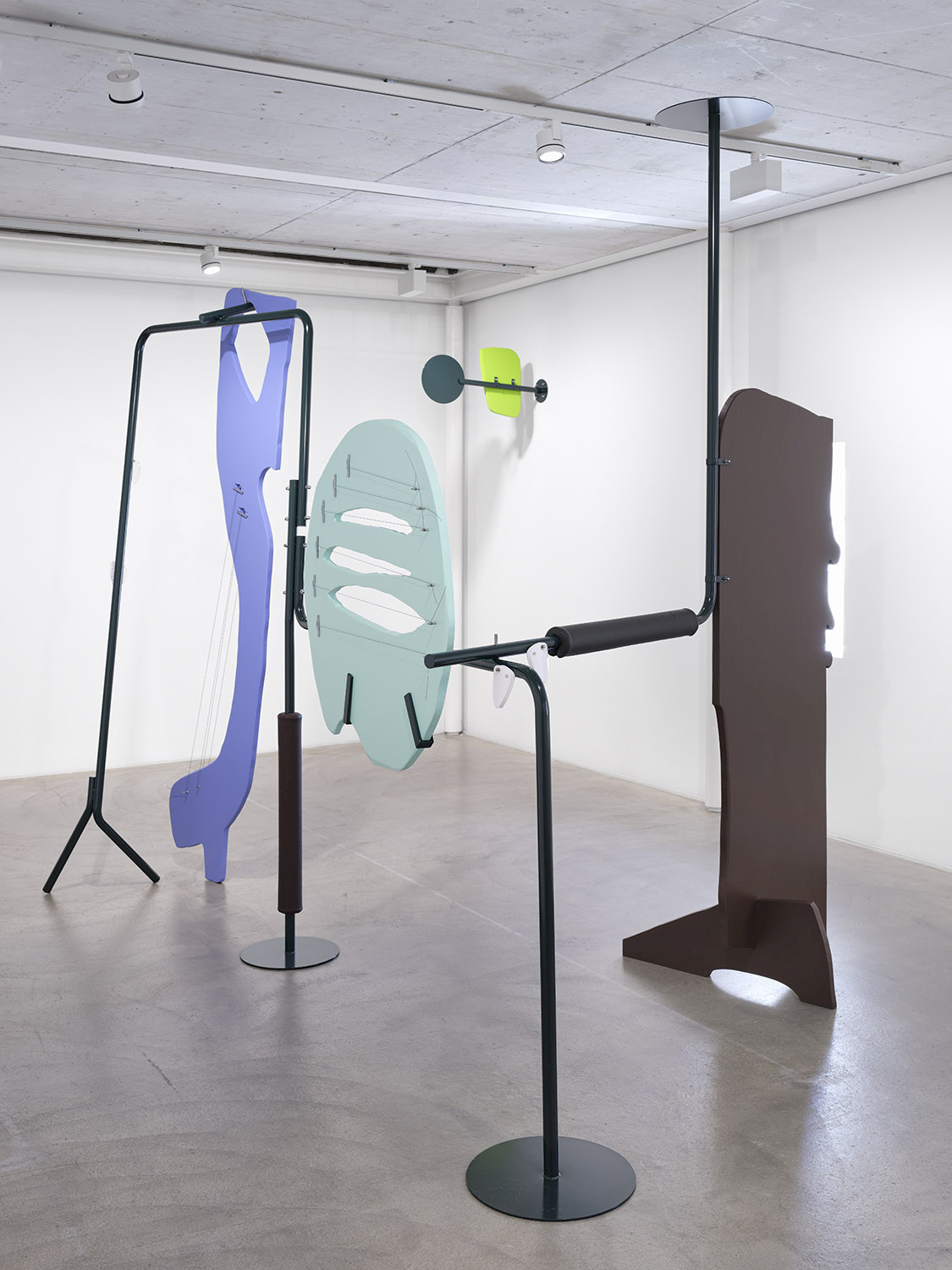
Installation view: Fragment and Organism - apricot extend, brown / mint / lilla, neon, 2026
Painted three-layer maple panels, string wire, powder-coated metal, row metal tube, acrylic paint and acrylic medium on fabric, beech wood rod, 3D nylon print
Dimensions variable
At "your Ambivalence" curated by Simone Neuenschwander
KunstRaum, Riehen 2018
(with Özlem Altin, Alexandra Bircken, Leda Bourgogne, Karin Hueber, Tina Janiashvili, Marta Riniker-Radich)

Installation view: Fragment and Organism - apricot extend, brown / mint / lilla, neon, 2026
Painted three-layer maple panels, string wire, powder-coated metal, row metal tube, acrylic paint and acrylic medium on fabric, beech wood rod, 3D nylon print
Dimensions variable

Installation view: Fragment and Organism - apricot extend, brown / mint / lilla, neon, 2026
Painted three-layer maple panels, string wire, powder-coated metal, row metal tube, acrylic paint and acrylic medium on fabric, beech wood rod, 3D nylon print
Dimensions variable

Installation view: Fragment and Organism - apricot extend, brown / mint / lilla, neon, 2026
Painted three-layer maple panels, string wire, powder-coated metal, row metal tube, acrylic paint and acrylic medium on fabric, beech wood rod, 3D nylon print
Dimensions variable

Installation view: Fragment and Organism - apricot extend, brown / mint / lilla, neon, 2026
Painted three-layer maple panels, string wire, powder-coated metal, row metal tube, acrylic paint and acrylic medium on fabric, beech wood rod, 3D nylon print
Dimensions variable

Fragment and Organism - apricot extend, 2026
Painted three-layer maple panels, string wire, powder-coated metal, row metal tube, acrylic paint and acrylic medium on fabric, beech wood rod, 3D nylon print
Dimensions variable

Fragment and Organism - apricot extend, 2026
Painted three-layer maple panels, string wire, powder-coated metal, row metal tube, acrylic paint and acrylic medium on fabric, beech wood rod, 3D nylon print
Dimensions variable
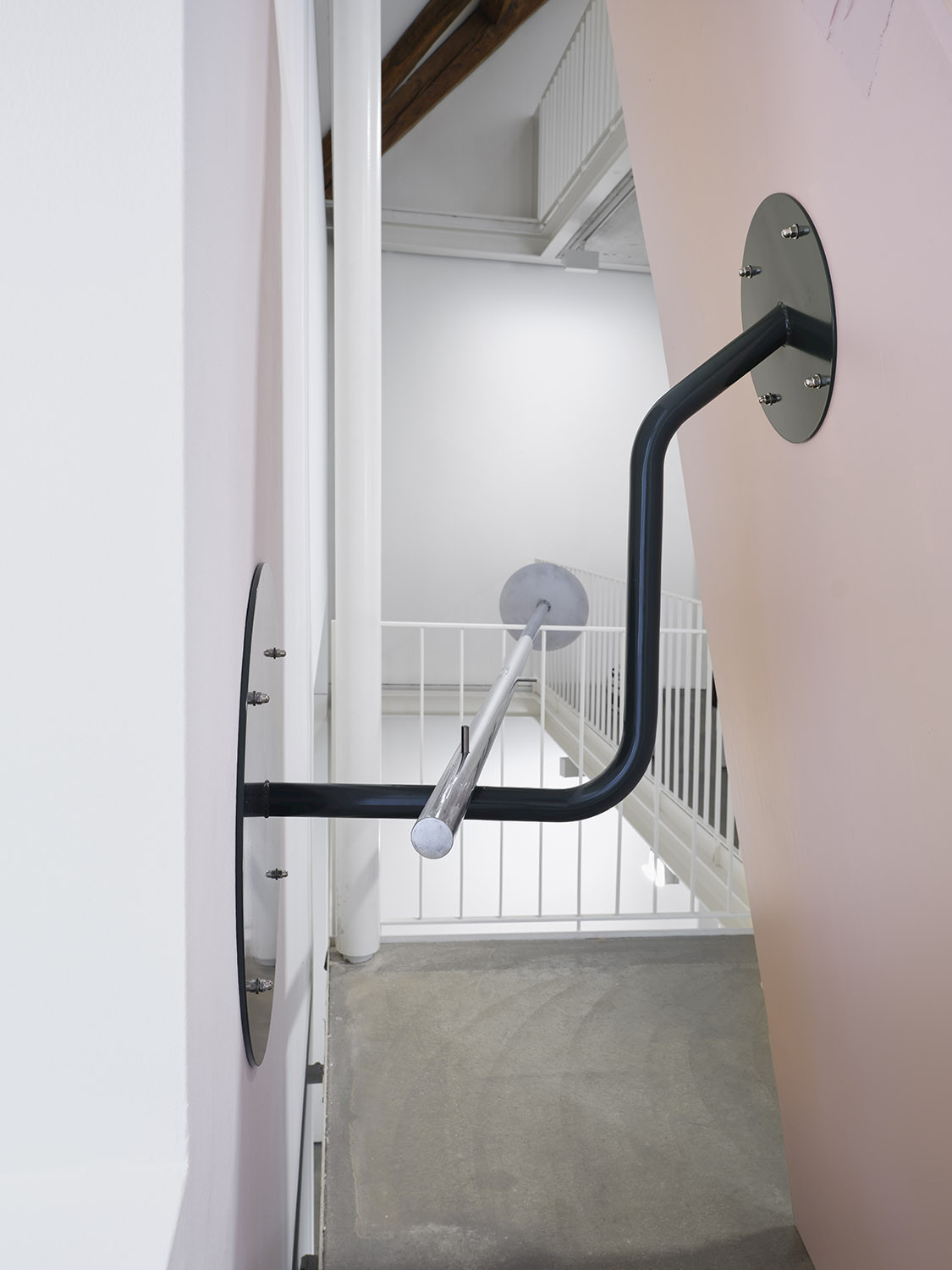
Detail: Fragment and Organism - apricot extend, 2026
Painted three-layer maple panels, string wire, powder-coated metal, row metal tube, acrylic paint and acrylic medium on fabric, beech wood rod, 3D nylon print
Dimensions variable

Fragment and Organism - neon, 2026
Painted three-layer maple panels, powder-coated metal, acrylic paint
Dimensions variable

Detail: Fragment and Organism - apricot extend, brown / mint / lilla, neon, 2026
Painted three-layer maple panels, string wire, powder-coated metal, row metal tube, acrylic paint and acrylic medium on fabric, beech wood rod, 3D nylon print
Dimensions variable

Installation view: Fragment and Organism - apricot extend, brown / mint / lilla, neon, 2026
Painted three-layer maple panels, string wire, powder-coated metal, row metal tube, acrylic paint and acrylic medium on fabric, beech wood rod, 3D nylon print
Dimensions variable
Fragment and Organism
On the first floor, Karin Hueber’s site-specific installation unfolds as a disparate ensemble. Wooden objects of varying sizes, painted in different colors, are connected to one another by metal rods, handles, and brackets, evoking a fictional stage, an abstract ob-stacle course, or a structure in public space. The forms are not clearly identifiable and oscillate between practicality and dysfunctionality. Oriented toward the human body, they suggest movements in space that evoke both physical exertion and relaxation. An important point of reference for the artist was the essay “Bodies–Cities” (1992) by the Australian philosopher and feminist theorist Elizabeth Grosz. In it, she argues that space not only directs physical movements but also influences orientation, identity formation, and social coding. In Karin Hueber’s sculptures, these connections are taken up yet still appear ambivalent: the familiar turns into the unfamiliar, potential optimization becomes ineffective, and functional design transforms into surreal architecture. At the same time, dependence, imitation, and adaptation become palpable, and the metal wires integrated into the sculptures open up a new dimension: the objects can become sound-producing instruments thanks to their playable strings. Using 3D-printed nylon tools—which hang from the metal frames and are also available in the foyer—visitors can “play” the objects. The sound spreads unpredictably throughout the space, much like the forms, intensifying the search for stability and balance. The sculptures’ potential function as instruments will culminate in a performance in which the artist and musician Yanik Soland will activate the objects (June 18, 2026, 6 pm). In the process, the works undergo a final “high-performance” moment: the space is acoustically expanded, and the sculpture temporarily becomes a dynamic organism.
Text by Simone Neuenschwander, Art historian and curator Kunst Raum Riehen